




























Eight Words That Prove Everything: What Gabriel's Greeting Reveals About Mary
Compressed inside eight words is the complete theological foundation for three Marian doctrines and three teachings that Catholics have believed and defended for two thousand years.
"Hail, full of grace, the Lord is with you." — Luke 1:28
If someone asked you to prove the major Marian doctrines of the Catholic Church, where would you begin?
Most Catholics reach for the Catechism. Some reach for papal declarations — Pius IX's Ineffabilis Deus defining the Immaculate Conception in 1854, Pius XII's Munificentissimus Deus defining the Assumption in 1950. Others reach for the Church Fathers, for councils, for centuries of theological tradition.
All of those are valid. All of those are important. But none of them is where the doctrines actually begin.
They begin in Nazareth. In a room. With an angel opening his mouth.
"Chaire, kecharitōmenē, ho Kyrios meta sou." "Hail, full of grace, the Lord is with you."
Eight words in Greek. One sentence. The first thing Gabriel ever said to Mary — spoken before the mission, before the explanation, before even her name. And compressed inside those eight words, waiting to be unpacked with nothing more than careful attention to the language, the grammar, and the internal logic of Scripture itself, is the complete theological foundation for three Marian doctrines and three teachings that Catholics have believed and defended for two thousand years.
This is not a devotional argument. It is not an appeal to tradition or authority. It is an argument from the text itself — from what Gabriel actually said, what his words actually meant in their original Greek, and what follows necessarily from those meanings when applied with consistent theological logic.
Doctrine 1 — Mary as Queen of Heaven
From the word: Chaire — Hail
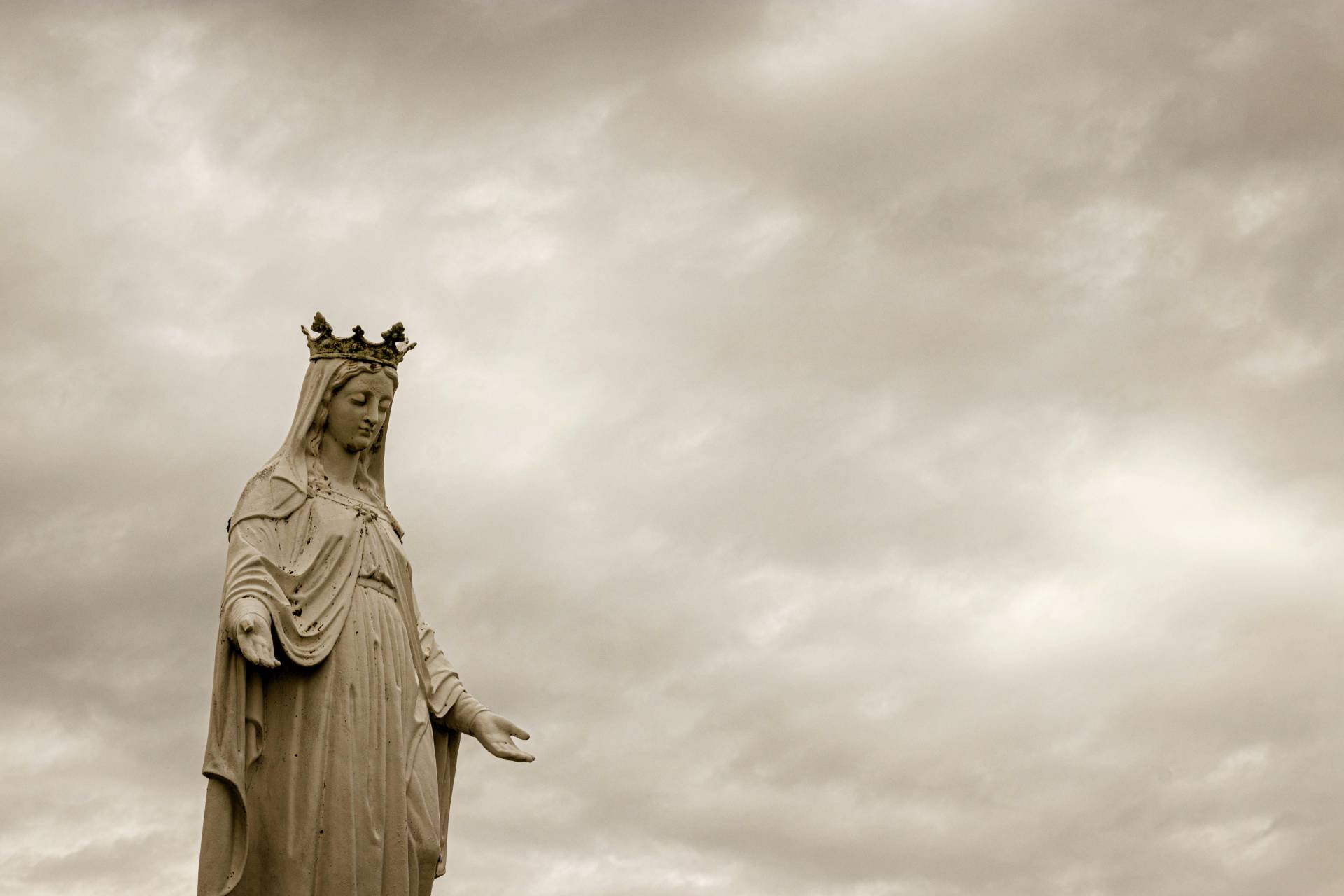
"Hail" is not a greeting. It is a coronation.
The prayer opens with a word that modern readers pass over almost without noticing. Hail sounds like a formal greeting — elevated, perhaps archaic, but essentially just hello. In the original Greek, it is nothing of the kind.
Chaire (χαῖρε) was not a standard salutation in the Greco-Roman world. It was the greeting reserved for royalty — the language of the royal court, spoken by subjects before sovereigns, used in formal address to kings and emperors and persons of the highest dignity. When Gabriel opens with chaire, he is not saying hello. He is delivering a royal salutation.
The theology of Mary's queenship follows directly. In the Davidic kingdom — the kingdom Gabriel is explicitly invoking when he tells Mary her Son will receive the throne of David (Luke 1:32) — the mother of the king held the formal office of Queen Mother. The Gebirah, the Great Lady, sat at the king's right hand. When Solomon was crowned, his mother Bathsheba sat beside him and he rose to meet her (1 Kings 2:19). The queen in the Davidic kingdom was not the king's wife. It was his mother.
If Jesus is the eternal Davidic King — and Gabriel says his kingdom will have no end — then Mary is the Queen Mother. And Gabriel knew it. Which is why before he said anything else, he addressed her with the language Heaven reserves for royalty.
Teaching 1 — The Nature of Mary's Sinless Being
From the word: Kecharitōmenē — Full of grace
This is where the argument becomes grammatically and philosophically precise — and where most translations fail the reader entirely.
Kecharitōmenē (κεχαριτωμένη) is a perfect passive participle of the verb charitóō, derived from charis — grace. The perfect tense in Greek describes a completed action whose effects continue permanently in the present. The passive voice declares that Mary is the recipient of this grace, not its origin. And critically — it functions in Gabriel's sentence not as an adjective describing Mary but as a noun identifying her. He does not say "Hail, Mary, who is full of grace." He addresses her as the graced one — using the word where her name would normally go, as her title, her identity, her name before God.
This distinction — between a quality someone has and a state someone is — is the entire key.
Most souls who receive grace have it, as a gift received, something added to their nature from outside. But kecharitōmenē places Mary in a different category entirely. Grace is not something she carries alongside other qualities. It is constitutive of her existence — what she is at the level of being itself. In scholastic terms, the difference between habere and esse. Between having and being.
And the perfect tense tells us this state has no beginning we can point to within time. It was not the result of something that happened at the Annunciation. It describes a permanent condition that pre-exists Gabriel's arrival — one that God established before time touched her.
Gabriel did not rename Mary. He revealed the name she already had in Heaven — the name God had always called her before the world knew it. What the grammar implies, the logic of the Incarnation will confirm.
Teaching 2 - The Economy of Saving Grace
From the root: Charitóō — The verb that appears only twice in all of Scripture
Kecharitōmenē is formed from the verb charitóō. That verb — in its various forms — appears exactly twice in the entire New Testament. Only twice, across every Gospel, every letter, every prophecy in the canon. And those two appearances are not random. Together they tell the complete story of what God is doing with humanity.
The first is Luke 1:28 — Gabriel's greeting to Mary. He uses it as a noun, in the perfect tense, describing a state of being that is permanent and timeless. Mary is the graced one. Static. Complete. Eternal.
The second is Ephesians 1:6 — Paul writing that God graced us (echaritōsen hēmas) in the Beloved, in Christ. He uses it as a verb, in the aorist tense, describing a divine action — something God does, actively and redemptively, to fallen humanity through Jesus.
The grammar encodes the theology with absolute precision.
For Mary, grace is a noun — because she has no before and after. She was never a sinner awaiting transformation. She was always already the graced one. The noun is the grammar of eternity, of what simply is without movement or change.
For us, grace must be a verb — because we are sinners who need to be acted upon. We need something to happen to us. We need the Fall reversed, the separation healed, death conquered. And God through Christ does exactly that — actively, verbally, redemptively — turning sinners into the sinless, death into life, the separated into the reconciled.
Kecharitōmenē is the name for the state of complete reconciliation with God. The state Heaven is. The state Mary inhabited on Earth. The state we are all moving toward through Christ — touching it partially in the Eucharist, reaching it fully only in the resurrection, when we too become, through Jesus, what Mary always simply was.
The word only needed to appear twice because those two appearances are the only two moments the biblical narrative needs to name this reality directly. The noun shows us the destination. The verb shows us the journey. Mary is where grace is. Christ is how it reaches us.
Teaching 3 — The Living Presence of God in Mary
From the phrase: Ho Kyrios meta sou — The Lord is with you
This is the most consistently misread line in Gabriel's greeting — and correcting the misreading opens an entirely new dimension of Marian theology.
"The Lord is with you" is almost universally read as encouragement. Divine reassurance. God is on your side. You are a faithful woman and he is with you in your mission. A warm and comforting declaration of divine favor.
This reading is wrong. Not wrong in spirit — but wrong in what Gabriel is actually doing grammatically and theologically.
Read in direct continuity with kecharitōmenē, the line is not encouragement. It is a statement of ontological fact — describing the same reality from a second angle, completing the same thought Gabriel already began.
Kecharitōmenē describes Mary's state from the inside: she is the graced one, God's own life filling her completely, no separation, no sin, no distance between her soul and her Creator.
Ho Kyrios meta sou describes the same reality from the outside: the Lord is with her — not metaphorically, not spiritually in some distant sense, but actually, physically, ontologically present — because when a soul is so completely filled with God's own life that sin is entirely absent, God is not merely near. He is there. Dwelling. Present. With.
The two phrases are synonyms. Gabriel is saying the same thing twice — once in the language of grace, once in the language of presence. Together they declare that Mary is the walking Eden — the first human being since the Fall in whom God's presence dwells not in shadow or symbol or through the mediation of temple and curtain and ritual, but fully, actually, without interruption, as the permanent condition of her existence.
The entire Old Testament — the tabernacle, the temple, the Ark of the Covenant, the cloud and fire in the desert — is the story of God reaching back toward his people after the Fall, dwelling among them in partial and shadowed ways, pointing forward to a restoration not yet complete. And then Gabriel stands before Mary and says: the Lord is with you. Not in a tent. Not behind a curtain. In her. In a human being. Fully. Actually. Now.
She is the walking Eden. The living temple. The restored presence. And the one who is already with her is about to be within her — the Lord who dwells in her by grace about to dwell in her by flesh.
Doctrine 2 — The Immaculate Conception: The Necessity of the Vessel
From the logic: The vessel must be adequate to the presence
Once you establish that Mary is kecharitōmenē — constitutively holy, sinless from the beginning, the living tabernacle of God's full presence — a further argument follows with the force of logical necessity. And this argument does not come from tradition or papal declaration. It comes from a principle Scripture establishes and never once contradicts.
God cannot dwell in what is not holy.
This is not an arbitrary rule. It is a statement about the nature of God himself. Sin is the privation of God's own life — the absence of the very thing he is. God's presence and sin are not merely morally incompatible. They are ontologically incompatible. Where one is fully present, the other simply cannot be. Light and darkness do not coexist.
Scripture encodes this principle in escalating precision across three structures.
The Ark of the Covenant had to be built to God's exact specifications because his presence was going to dwell within it. The vessel had to match the holiness of what it contained. Touch it improperly and you die — not as arbitrary punishment, but as the natural consequence of finite sinfulness colliding with infinite holiness.
The Eucharist applies the same principle to the human person. We cannot receive God himself — truly and substantially present in the body and blood of Christ — while in a state of mortal sin. Paul is explicit: to receive unworthily is to eat and drink judgment upon yourself (1 Corinthians 11:27-29). Confession is required not as a bureaucratic obstacle but as the sacramental expression of the same ontological principle — the vessel must be made holy before it can contain God's presence.
And yet even worthy Eucharistic reception does not bring us into the fullness of kecharitōmenē. We still bear death. We still carry concupiscence. We enter a real and sacred foretaste — a pre-kecharitōmenē, a genuine but partial and temporary dwelling of God within us — but not the permanent, constitutive fullness that kecharitōmenē names. That awaits Heaven.
Now apply both principles to Mary — without flinching from where they lead.
Mary was not asked to carry the Ark. She was not asked to receive the Eucharist. She was asked to carry God himself — personally, physically, biologically present as a child formed from her own flesh. The eternal Son of God took his human nature from her body. His humanity was constituted from her flesh.
If the Ark required exact specifications. If we must confess before receiving God sacramentally — and even then we only touch the foretaste, not the fullness. Then what must the vessel be that carries not the symbol of God's presence, not God sacramentally present, but God himself, in person, in flesh, formed from her body?
She must be kecharitōmenē. Not approaching it. Not restored to it by confession. Not touching it temporarily. Simply, permanently, from the very first instant of her existence, being it — because anything less is a vessel inadequate to what it is asked to contain.
You cannot be a sinner first and sinless second and then carry God. Because that sequence implies a before — a state of separation, a state in which God's presence was incompatible with your being — and an after achieved by preparation. And preparation, however holy, is not the same as a nature that was never touched by the incompatibility in the first place.
The Immaculate Conception is not an added extra. It is the only version of Mary that makes the Incarnation coherent. Gabriel declared it before anything else — kecharitōmenē — because without it, nothing that follows is possible.
Doctrine 3 — The Assumption of Mary
From the connection: Sin produces death. Mary had no sin. Therefore death had no claim on Mary.
The final doctrine follows from everything that has come before — and it follows with the same logical force, from the same source, requiring no appeal to tradition beyond what the text itself already establishes.
Paul states the principle plainly in 1 Corinthians 15:56: "The sting of death is sin." And in Romans 5:12: "Sin entered the world through one man, and death through sin." Death is not an arbitrary feature of human existence imposed from outside. It is the natural consequence of separation from God, who is life itself. Sin introduced the separation. Death is what that separation produces in creatures of flesh and soul — working itself out in bodily corruption as the outward expression of an inward spiritual rupture.
Sin and death are bound together at the root. They are not independent realities operating in parallel. Death is the fruit of sin the way darkness is the fruit of the absence of light. Remove the cause and the effect has nothing to work on.
Mary was kecharitōmenē. Sinless from the first instant of her existence. Never separated from God. Never touched by the privation that sin introduces. The root from which death grows was simply absent in her — not removed, not healed after the fact, never present in the first place.
If sin produces death, and Mary never had sin, then death had no cause to work from in her. No claim to execute. No sentence to carry out on a nature that had never incurred it. The mechanism by which death exercises dominion over human beings — the separation from God that sin introduces — was simply not present in the woman who was constitutively, permanently, from eternity, kecharitōmenē.
And beyond the absence of death's cause, there is the positive reality of what her body was. The living tabernacle of the Incarnation. The vessel that provided the flesh from which God took his own human nature. The body that carried what no other body in human history had been asked to carry. That body could not be left in the earth to undergo the corruption that sin produces — not as a privilege granted from outside, but because corruption had no claim on it and never did.
The Assumption is kecharitōmenē applied to the body. The same state that defined her soul, now completed in her flesh. Body and soul together, fully and finally, in the Heaven she already embodied on Earth.
Eight Words. Three Teachings. Three Doctrines. One Sentence.
Stand back and look at what has just been established — and where every word of it came from.
The Queen of Heaven — from chaire. The ontology of Mary's sinless being — from kecharitōmenē as noun. The economy of saving grace across all of Scripture — from charitóō appearing exactly twice. The living presence of God in Mary — from ho Kyrios meta sou. The theological necessity of the Immaculate Conception — from the logic of the vessel and the presence. The theological inevitability of the Assumption — from the inseparable connection between sin and death.
Three doctrines and three teachings. No appeal to tradition as the starting point. No argument from authority. Nothing except careful attention to what Gabriel actually said, what his words actually meant in their original Greek, and what follows necessarily when that meaning is applied with consistent theological logic.
This is the apologetics argument that never gets made — because most people, Catholic and non-Catholic alike, read Gabriel's greeting as a pleasantry. As an introduction. As the warm-up before the real announcement begins.
It was never a warm-up. It was the announcement. Everything Gabriel needed to declare about Mary — her nature, her identity, her role, her sinlessness, her queenship, her destiny — was already present in the first sentence he spoke. The rest of his message was the mission. The theology was already complete in the greeting.
"Hail, full of grace, the Lord is with you."
Eight words. The most theologically dense sentence any creature has ever spoken to another. And the proof — from Scripture alone, from grammar alone, from logic alone — of everything the Catholic Church has always believed about the woman who said yes.
May the Lord bless you and keep you.

About the author
I'm a Catholic layman from Fort Lauderdale, Florida. No seminary, no credentials — just a deep love for the Faith and a conviction that ordinary Catholics are called to evangelize.
Related articles
Apologetics
The Perpetual Virginity of Mary: A Complete Linguistic, Historical, and Theological Defense
The perpetual virginity of Mary — the teaching that Mary remained a virgin before, during, and after the birth of Jesus — is one of the oldest and most consistently held beliefs in Catholic and Orthodox Christianity.

Join the community
Subscribe to our weekly newsletter for curated inspiration, delivered to your inbox.
We never share your data. See Privacy Policy for more info.